
Weather System
WebGPU
A 36 Million-Splat Snowstorm in Chrome: When a Digital Twin Starts Behaving Like a World
July 07, 2026 · By Unreal Twin
A static digital twin is a record of a place. A useful runtime should be able to make that place respond.
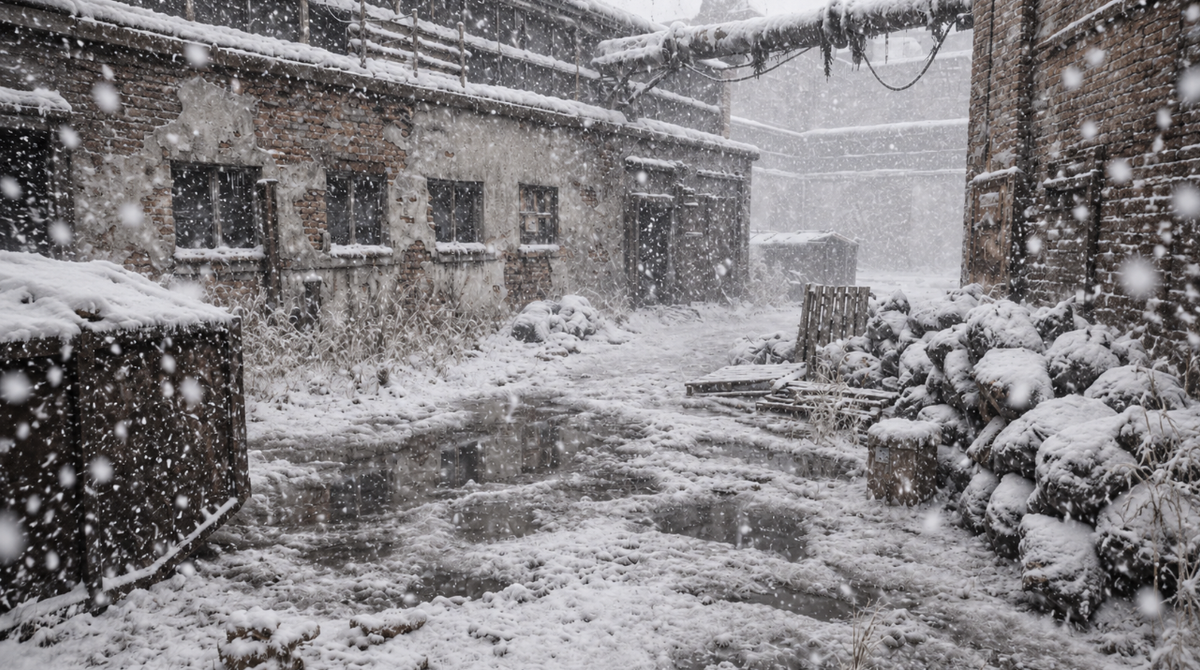
That was the point of the snowstorm built across Scans Factory’s Abandoned Factory environment. The scene is already a serious browser workload: multiple industrial buildings, complex interiors and exteriors, and roughly 36 million Gaussian Splats. Adding snow as a screen overlay would have been easy. Making the snow understand the environment was the real test.
The system was built on top of PlayCanvas particle foundations with a custom WebGPU-driven interaction layer. Snow particles do not simply pass through the scene. They use the spatial environment to decide where they can fall, where they should stop, and where accumulation should appear.
“
A living digital twin is not a static scene with effects placed in front of it. The environment and the effect have to understand each other.
”
Snow outside should not mean snow everywhere
Indoor occlusion is the quickest way to expose a fake weather system. A blizzard may look impressive in an exterior shot, but the illusion collapses when particles continue through a roof. UnrealTwin’s weather layer respects the architecture, clipping snow when the viewer moves beneath covered areas and allowing it to return when the space opens again.
Surface accumulation follows the same principle. Instead of applying a universal white tint, the system uses the underlying scene orientation so snow gathers on upward-facing floors, ledges, roofs, and other plausible surfaces. The result is not a physically exhaustive simulation, and it does not need to be. It is a carefully chosen set of rules that makes the world feel responsive at a cost the browser can sustain.
The performance target matters as much as the effect. The scene remains a massive 3DGS environment while the browser handles particles, spatial tests, accumulation logic, and rendering. A feature that only works after reducing the environment to a polite demo would miss the point.
Runtime intelligence changes the value of a capture
A raw scan can document current conditions. A runtime can use that spatial foundation for training, seasonal presentation, emergency visualization, operations, storytelling, and remote collaboration. Weather is one example, but the architectural idea extends much further: environmental state, guided events, sensor overlays, sound zones, access rules, annotations, and shared presence all become possible once the platform understands where things are.
The 36-million-splat snowstorm matters because it proves that scale and response do not have to be separate milestones.
The Abandoned Factory can be explored through the current live Abandoned Factory snow scene. The larger direction is more important than a single scene. UnrealTwin is moving from a tool that displays captured worlds toward a runtime that lets those worlds participate in the experience.
The next generation of digital twins will not be judged only by how accurately they preserve a moment. They will be judged by what can happen after the moment has been captured.