
Unreal Engine
WebGPU
Why Unreal Engine Still Does Not Run Like a Website — and Why UnrealTwin Exists
November 15, 2025 · By Unreal Twin
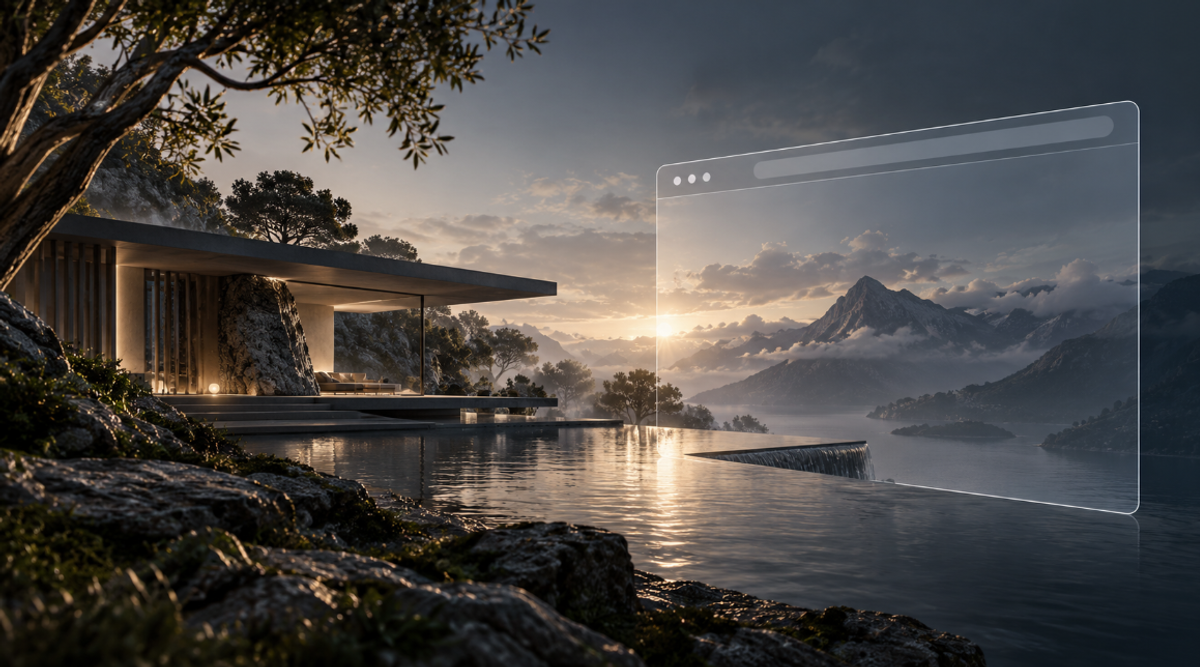
Unreal Engine can produce some of the most convincing real-time environments in the world. It can also be surprisingly difficult to show those environments to the people who actually need to see them. A polished UE5 scene usually ends its journey as an executable, a packaged application, a video, or a remotely rendered stream. None of those behaves like a normal website.
Inside the studio, that may not feel like a problem. The project runs on a known workstation, with the right GPU, drivers, plugins, and build settings. Outside the studio, every one of those assumptions becomes friction. A client may need an installer. A sales team may need a special machine. A reviewer may need remote access. A public visitor may simply leave when the download begins.
The distribution gap is now the real bottleneck
For games and specialist applications, software delivery is expected. For architectural visualization, digital twins, interactive showrooms, design reviews, exhibitions, and artist portfolios, it is often the wrong model. These experiences are meant to be opened by people who did not help build them. They should travel through a proposal, a message, a product page, or a social post and begin with one click.
When people say they want to run Unreal in a browser, they usually mean one of two things. They either want the complete Unreal application streamed from a remote GPU, or they want the visual result of the Unreal scene to behave like native web content. Those are very different products.
“
The browser is the world’s largest distribution platform. Unreal Engine is one of the world’s strongest creation tools. UnrealTwin exists to close the gap between them.
”
Pixel Streaming preserves the full runtime because Unreal continues to run on a remote machine. That is powerful, but the browser is still receiving a video stream and returning input. The scene has not become a web asset. It remains a live application being operated somewhere else.
UnrealTwin changes the representation
UnrealTwin takes a different route. It converts the authored visual environment into a lightweight spatial representation built around 3D Gaussian Splatting, then delivers it through a WebGPU-powered browser runtime. The goal is not to hide a packaged UE5 build inside a browser tab. The goal is to preserve the qualities that made the scene valuable, its lighting, density, composition, scale, and atmosphere, while giving it a distribution model that belongs to the web.
That distinction removes a major operational burden. The viewer’s own device performs the rendering. The experience can be linked, embedded, revisited, and placed inside a larger website without assigning a remote Unreal session to every visitor. Quality can adapt to desktop and mobile rather than assuming one controlled machine.
There are honest tradeoffs. Blueprints, gameplay code, physics, and fully dynamic Unreal lighting do not automatically survive conversion. Interaction has to be designed for the web product that is actually needed. In many cases, that is the right compromise. A property presentation does not need an entire game runtime to let a buyer walk through it. An environment artist does not need a cloud GPU to let a recruiter inspect a scene. A digital exhibition should not need an installation guide.
The product is reach, not merely compression
UnrealTwin is not valuable because it makes a file smaller. It is valuable because it changes who can enter the work, how quickly they can enter it, and what it costs to keep the door open.
Real-time artists have spent years pushing fidelity. The next hard problem is making that fidelity useful beyond the author’s machine. UnrealTwin treats distribution as part of the graphics problem, not as an afterthought added once the scene is finished.
The ambition is simple to state and difficult to engineer: make high-end Unreal work behave like the web. Open a link. Enter the world. Share it again.