
Gaussian Splatting
Web Publishing
From UE5 Scene to Web Link: What UnrealTwin Actually Converts
December 15, 2025 · By Unreal Twin
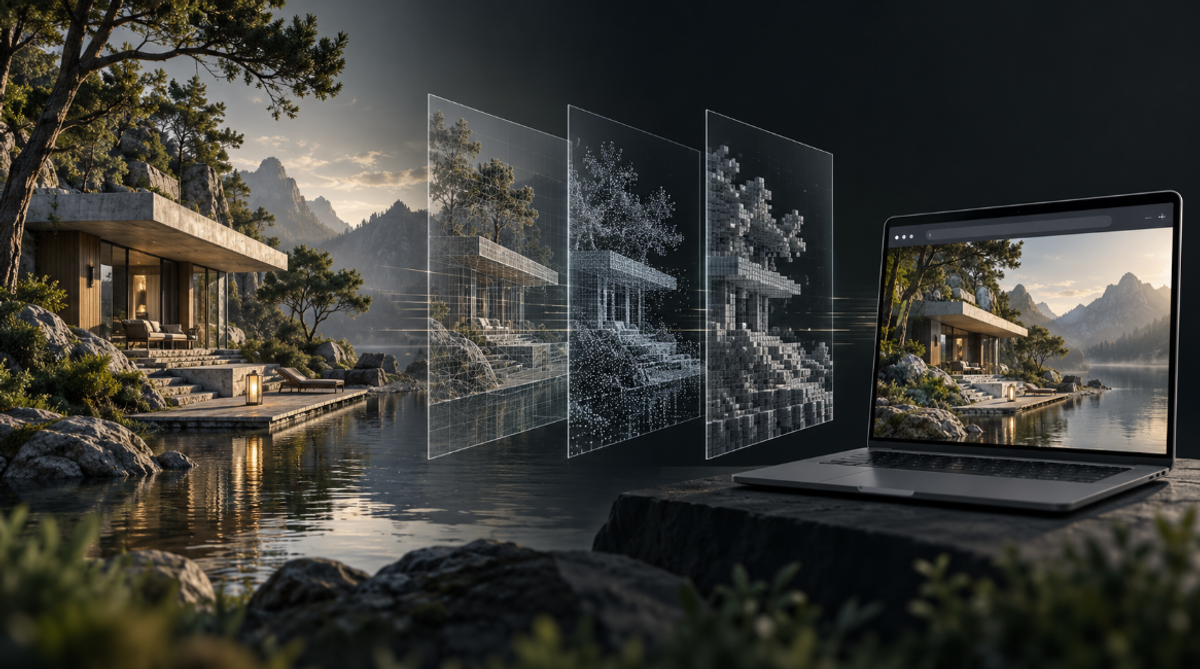
“Convert an Unreal Engine scene to the web” sounds like a file-format problem. It is not. A UE5 environment is a stack of systems: geometry, materials, textures, lighting, post-processing, particles, sound, collision, cameras, Blueprints, and project logic. A useful web conversion begins by deciding which parts of that stack carry the experience and which parts belong only to the original runtime.
The visual result is the starting point
UnrealTwin is built around preserving what the audience sees. The authored environment is converted into a 3D Gaussian Splat representation that can retain dense geometry, baked lighting, reflections, surface character, and the overall composition of the Unreal scene. This is especially valuable for scenes whose identity depends on Lumen, Nanite-scale density, layered assets, or expensive materials that would be difficult to rebuild as a conventional web mesh pipeline.
The important wording is visual result. UnrealTwin does not place the original Nanite geometry or Lumen renderer inside Chrome. It captures their contribution and translates that appearance into a representation the browser can render efficiently.
That is why a conversion can preserve a scene that would otherwise be impractical on the open web. The web experience carries the look without carrying every cost that produced the look.
Optimization is not a final export checkbox
A raw splat is not automatically a web product. Large environments still need cleanup, segmentation, streaming, device-aware quality, GPU sorting, and carefully generated levels of detail. Without that work, a technically valid scene can load slowly, consume too much memory, shimmer at distance, or fall apart on mobile.
“
A browser-ready Unreal experience is not a 3D file placed online. It is a second production pipeline built around distribution.
”
UnrealTwin’s runtime decides how much information is needed, when it should arrive, and how it should be rendered on the current device. That is the difference between a demo that works on the engineer’s desktop and a link that can be sent to a client without an instruction manual.
Interaction is rebuilt around the purpose
Not every Unreal interaction should survive, and not every web experience needs it. A property walkthrough needs reliable navigation, collision, annotations, and perhaps a guided route. A digital exhibition may need hotspots, audio, shared presence, and embedded commerce. An artist portfolio may need a cinematic starting view and free exploration. A product launch may need controlled camera moments and clear calls to action.
These are web-product decisions, not mechanical exports. The environment becomes the foundation, then the useful interactions are added deliberately. Weather, spatial audio, shader-driven motion, post-processing, and other runtime systems can restore the sense that the world is active without pretending the complete UE project is still running.
What does not transfer automatically
Blueprint graphs, gameplay systems, runtime physics, Niagara setups, dynamic Lumen, and application UI do not simply reappear in the browser. Some can be recreated with web-native systems. Some can be represented more efficiently. Some should be left behind because they do not serve the final audience.
The conversion succeeds when the viewer stops asking what was removed and starts responding to what was preserved: the space, the atmosphere, the scale, and the freedom to explore.
This is the honest value of UnrealTwin. It is not a magical “export to HTML” button for every UE5 feature. It is a platform for giving high-fidelity Unreal environments a second life as scalable, interactive web experiences.
The source remains Unreal Engine. The destination behaves like the web.