
Your 3D Art Deserves More Than a 2D Portfolio
September 21, 2026 · By Unreal Twin
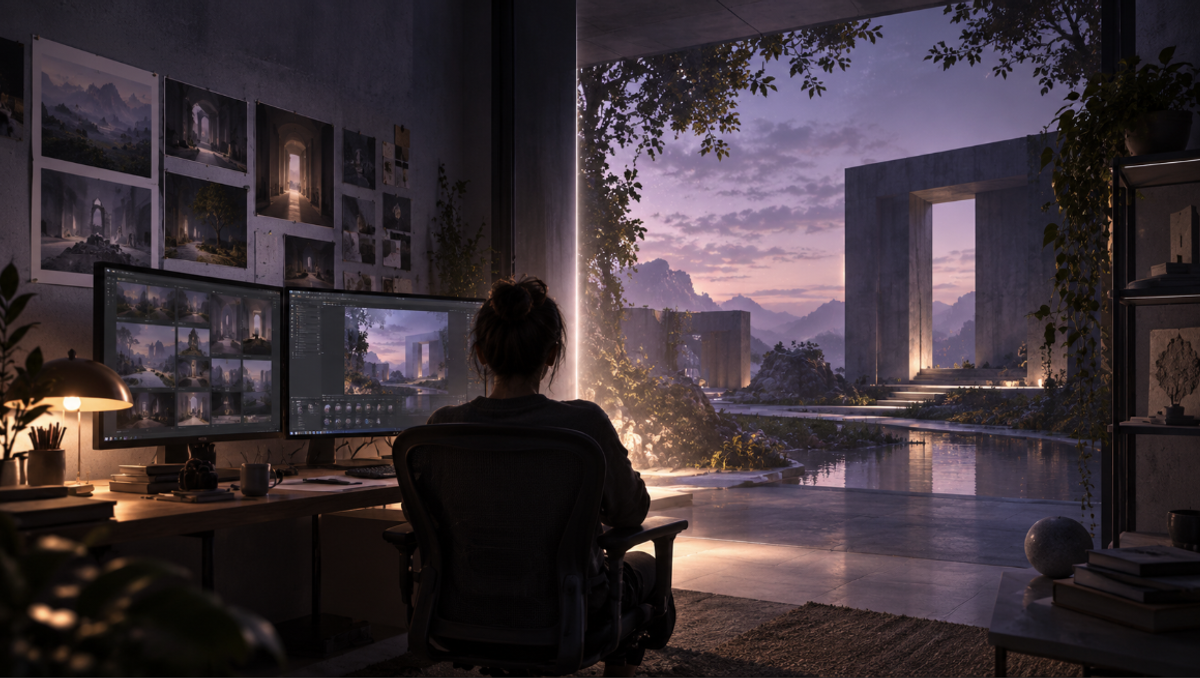
ArtStation is excellent at what it does. It gives artists a global place to publish images, breakdowns, turntables, and video. The contradiction is that most 3D work still reaches the audience as 2D evidence.
An environment artist may spend months shaping sightlines, lighting transitions, material response, traversal, and small discoveries that only make sense while moving through the scene. The portfolio then reduces that work to six selected images and a compressed fly-through. The craft is visible, but the spatial judgment is not.
Let the viewer inspect the decisions
UnrealTwin allows a finished Unreal environment to become a browser-based experience. A recruiter, art director, client, or fellow artist can open one link and move through the work without downloading a build or owning a high-end GPU.
That changes what the portfolio proves. A still image can hide weak areas outside the frame. A walkable scene shows that the artist understands composition across a route, maintains quality through transitions, and can build a world that holds together beyond a hero shot. It also gives technical artists a place to demonstrate scale, optimization, environmental systems, post-processing, and interaction as part of the work rather than as a paragraph below it.
“
A 3D artist should not have to flatten the strongest part of the work—the space itself—before anyone can review it.
”
The experience does not need to abandon curation. A strong portfolio scene can open from a deliberate camera, offer a guided sequence, and then allow free exploration. Annotations can reveal breakdowns in context. A visitor could inspect a material study while standing beside it, compare an early composition with the final scene, or hear the ambient soundscape where it was designed to play.
A link travels further than a build
Portfolio friction is easy to underestimate. Recruiters review quickly. Clients may be on managed hardware. Social audiences are usually on phones. A multi-gigabyte executable asks for trust and time before the work has earned either. Pixel Streaming removes the installation but makes every portfolio visit dependent on cloud infrastructure.
A web-native scene can live in the artist’s own site, in an application, inside a studio case study, or behind a link shared on LinkedIn. It can remain available without the artist running a GPU server for occasional traffic. Quixel’s Military Trench, Scans Factory Abandoned warehouse in Snow, and Leartes’ Amsterdam show how very different environment styles can be presented through the same access model.
The portfolio becomes more than proof that the final frame looked good. It becomes proof that the world was worth entering.
This is especially important as AI makes competent images easier to produce. A polished frame will remain valuable, but it will carry less information about authorship and systems thinking. A complete spatial experience reveals decisions across lighting, layout, continuity, optimization, and interaction that are harder to fake and easier to discuss.
UnrealTwin does not replace ArtStation. It gives the portfolio a destination beyond the thumbnail. Publish the images, share the breakdown, and then let people step inside the work.