
ArchViz
Client Presentation
Immersive Walkthrough
How Architectural Visualization Can Benefit From UnrealTwin
August 31, 2026 · By Unreal Twin
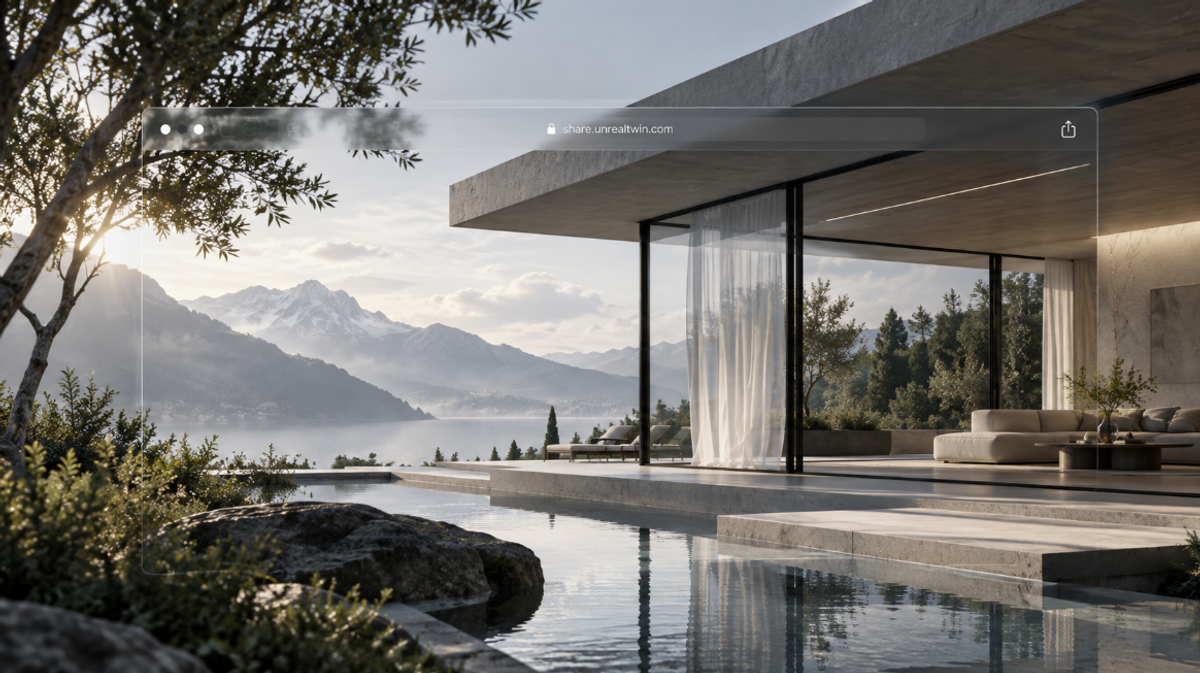
Architectural visualization has become extraordinarily good at producing images. The industry can communicate material, light, landscaping, furniture, and atmosphere at a level that was unthinkable a decade ago. The weak point is no longer the render. It is what happens after the render is approved.
Most projects are still delivered as a gallery of stills, a film, or a packaged real-time application. Stills are precise but selective. Film is emotional but controlled by the editor. A packaged Unreal walkthrough gives freedom, but it creates downloads, hardware requirements, versioning, and support work. Pixel Streaming removes the download while introducing cloud-GPU cost and operational complexity.
ArchViz needs a better last mile
UnrealTwin gives the finished Unreal scene a web-native destination. The environment can be converted into a high-fidelity Gaussian Splat experience that opens from a link and renders on the visitor’s device. The client does not need Unreal Engine, a project build, or a gaming workstation. The work can sit inside a presentation, project website, sales page, or private review portal. See a live architectural visualization example running through the same browser-first delivery model.
For the visualization studio, this changes the value of the deliverable. The project is no longer limited to a fixed set of camera angles. Clients can understand the route from entrance to living space, inspect sightlines, compare the relationship between rooms, and experience the scale of a double-height volume or landscape edge at their own pace.
“
ArchViz has solved the problem of making architecture look real. UnrealTwin addresses the next problem: letting the client enter that work without turning delivery into an IT project.
”
The visual quality matters. UnrealTwin can preserve the authored result of Lumen lighting, dense assets, reflections, and complex set dressing without asking the browser to run the original UE5 renderer. This is particularly useful for interiors and premium developments where atmosphere carries as much value as geometry. Art Gallery and Carpenter’s Workshop show two opposite ArchViz conditions—minimalism and extreme density—delivered through the same browser model.
Review becomes spatial instead of screenshot-based
A client review often turns into a trail of marked-up images and comments such as “the wall behind this camera” or “the view from the other side.” A walkable web experience gives everyone a common spatial reference. Annotations can sit where the issue exists. Guided viewpoints can preserve the intended presentation while free movement remains available for inspection.
Shared Presence extends that idea further. The architect, visualization artist, developer, and client can enter the same environment and discuss a decision in place rather than translating it across a screen share. That does not replace drawings or BIM coordination. It improves the layer where design intent is understood.
The scene can keep working after final delivery
ArchViz studios usually finish a project and archive the source. UnrealTwin creates additional uses for the same investment: a sales experience, public consultation, design exhibition, competition entry, stakeholder review, marketing embed, or permanent case study.
The commercial opportunity is not simply charging for another output. It is turning a finished visualization into an asset the client can continue using.
This also strengthens the studio portfolio. Instead of showing only selected frames, the studio can let future clients inspect composition, lighting, and spatial storytelling directly. The quality of the work no longer has to be compressed into a thumbnail grid.
For ArchViz, UnrealTwin is not a replacement for stills or film. Those formats remain essential. It is the missing spatial layer between a beautiful render and a difficult real-time build: high-fidelity work, opened from a link, with enough freedom to understand the architecture.