
Digital Twin
Web3D
Spatial Web
From Gaussian Splat Viewer to Web-Native Runtime: What UnrealTwin Is Building
September 16, 2026 · By Unreal Twin
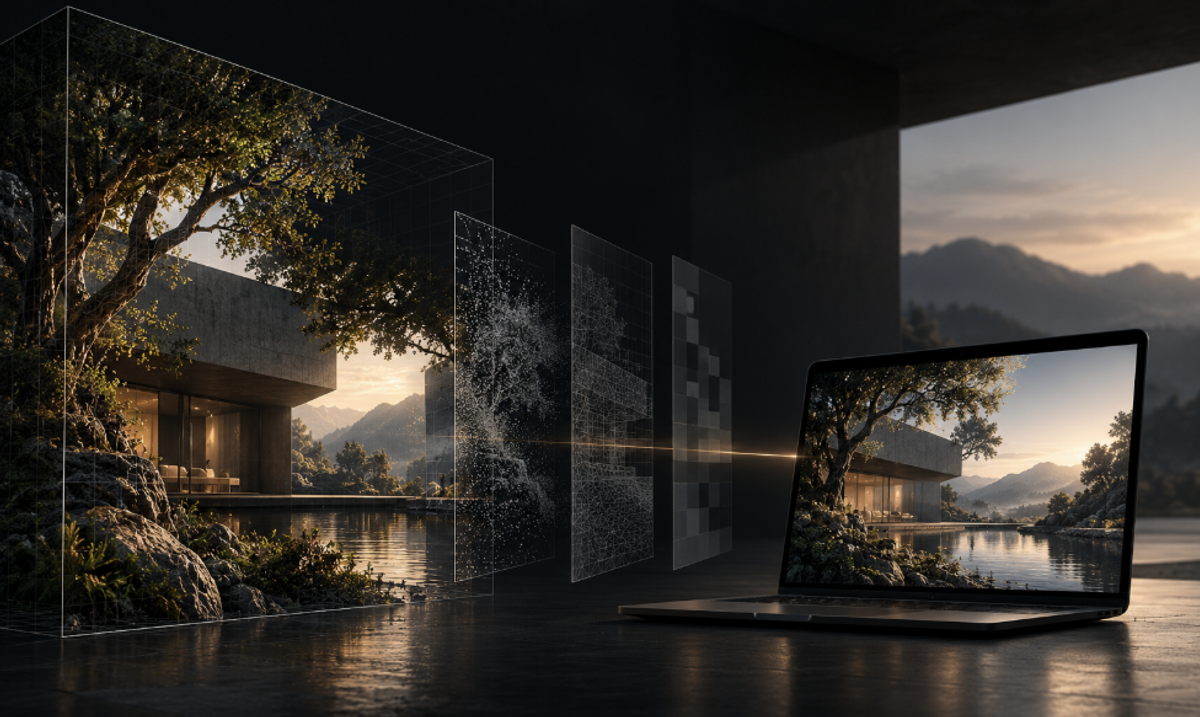
The first generation of Gaussian Splat products answered a necessary question: can this representation be viewed in a browser? The answer is yes. That achievement opened the door, but a viewer is not the final product. A viewer displays a place. A runtime gives that place rules.
Those rules determine what happens when a visitor walks under a roof, approaches a sound source, moves from desktop to mobile, looks across a huge scene, or enters the same space with another person. They determine whether the environment remains a static capture or begins to function as a digital product.
The milestones are beginning to connect
UnrealTwin’s recent work can look like a series of separate engineering experiments: a snowstorm across a 36-million-splat factory, shader-driven movement in Amsterdam, spatial-audio heatmaps, depth-aware WebGPU post-processing, compute sorting, native Gaussian LODs, progressive streaming, and walkable collision.
Read together, they form a runtime architecture. Weather needs spatial awareness. Motion needs efficient splat manipulation. Audio needs position and occlusion. Post-processing needs depth. Navigation needs collision. Large environments need LOD and streaming. Each feature makes the others more useful because the platform understands more than how to draw the scene.
The Unreal project remains the creative source. It is where artists establish lighting, materials, composition, set dressing, and visual language. UnrealTwin gives the finished environment a second life on the open web. Some qualities are captured; others are recreated with web-native systems where they add real value.
“
The goal is not to rebuild every feature of Unreal Engine. It is to build the systems a high-fidelity web experience actually needs.
”
A runtime changes the business value of the scene
An architectural environment can become a walkable client presentation. A digital twin can gain annotations, sensor context, and shared access. An environment artist can publish a portfolio visitors enter instead of watch. A product launch can use a spatial experience inside the campaign itself. A cultural space can remain open after the physical event ends.
These industries do not need the same interface, but they share the same distribution problem. High-fidelity 3D has been too heavy, too expensive, or too operationally complicated to behave like ordinary web media.
When the environment becomes a web-native asset, sharing stops being a technical event. A link can sit in a proposal, message, listing, product page, learning platform, or public gallery. The work can remain live without keeping a remote Unreal machine running for every possible visitor.
A scene that costs money every minute it is viewed will be rationed. A scene that behaves like hosted content can become part of everyday communication.
UnrealTwin is moving from viewer to runtime because the next generation of digital twins cannot remain static snapshots. They have to be walkable, responsive, shareable, and eventually social.
“It runs in a browser” is the first milestone. The higher standard is that the environment feels designed for the browser—and useful enough to become part of a real product.