
LOD
GPU Sorting
Massive Unreal Environments in a Browser: The Real Work Is LOD, Sorting, and Streaming
April 08, 2026 · By Unreal Twin
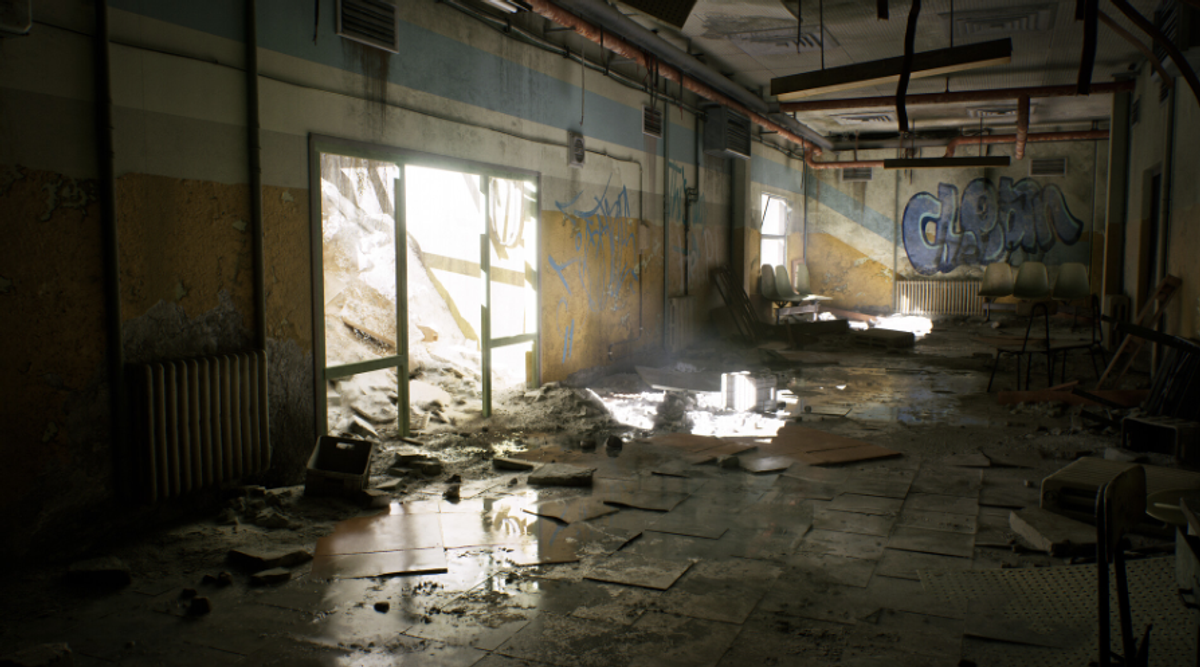
3D Gaussian Splatting can make an Unreal environment easier to distribute, but it does not make scale disappear. A small scene can hide a weak pipeline. A massive, asset-dense environment exposes every problem at once: sorting cost, memory pressure, loading time, distant detail, mobile limits, and visible LOD transitions.
The Derelict Corridor is not a polite demo
Quixel’s Derelict Corridor is long, dense, and visually repetitive in exactly the ways that punish real-time delivery. The viewer can see far through the facility, so large parts of the scene remain relevant at the same time. Fine debris, layered surfaces, and repeated industrial detail create an enormous amount of visual information.
A workstation can attack that with brute force. A public web experience cannot assume an RTX-class GPU, unlimited memory, or a controlled network. It has to decide what to render, what to load, and what to simplify without making the environment collapse.
Sorting belongs on the GPU
Gaussian Splats are view-dependent and need correct ordering for transparent compositing. As the scene grows, sorting becomes one of the main frame costs. UnrealTwin moves this workload into custom WebGPU compute shaders, letting the GPU process the parallel work while the CPU remains available for interaction and scene management.
“
Gaussian Splatting is the representation. LOD, sorting, and streaming are what turn it into a product.
”
Generic decimation is not a real LOD system
Removing splats uniformly may reduce file size, but it often destroys structure. Distant surfaces become noisy, fine objects dissolve, and transitions appear as popping or voxel-like changes in density. A good LOD is not simply a smaller version. It is a better allocation of detail.
UnrealTwin’s native LOD pipeline is designed to preserve perceptually important forms as distance changes. Complexity returns progressively as the viewer approaches, reducing the sense that the environment is switching between unrelated datasets.
Streaming solves the other half of the problem. The full scene should not become a gate that must be downloaded before the first useful frame. Relevant data arrives first, with more detail requested according to position, view, and likely movement. The total environment can be enormous while the immediate experience remains practical.
Desktop and mobile need different decisions
A phone is not a desktop with every slider lowered. The devices differ in memory, thermal limits, input, resolution, and sustained performance. Separate quality presets allow splat density, post-processing, streaming behavior, and other systems to be tuned around the actual device class.
The goal is not identical pixels on every screen. It is consistent intent: the same place, the same route, and the same visual hierarchy at a quality the device can sustain.
Explore the current Derelict Corridor directly in UnrealTwin. The scene demonstrates why the moat is not simply “we use 3DGS.” Many tools can display splats. Fewer can keep a large Unreal environment readable, responsive, and immediately accessible through a normal web link.
High fidelity at scale is not one breakthrough. It is a chain of unglamorous decisions that all have to work at the same time.